

Drake Stadium’s Enduring Legacy
Drake Stadium opened on October 10, 1925, with the Bulldogs defeating Kansas State in a football game. Drake Stadium was designed to be the home of Drake University football and, famously, the annual Drake Relays: “America’s Athletic Classic.” Even before that, incredible athletes gathered to compete as early as 1910 when the University hosted the first Drake Relays at Haskins Field, the precursor to Drake Stadium.
“The Drake Relays are unique in Iowa; it’s the only annual sporting event where fans can consistently see Olympic gold medalists perform,” said Mike Mahon, former sports information director at Drake University. “With over a hundred years of history dating back to 1910, it’s a given that rain or shine, athletes will deliver world-class times and distances amidst vibrant pageantry.”
Drake Stadium has hosted the Drake Relays, Drake football games, and a variety of high school football games. The high school contests often included rivalry games between teams like West Des Moines Valley High School and Dowling Catholic High School. The stadium also served as the home field for Des Moines Roosevelt High School’s football team for several years.
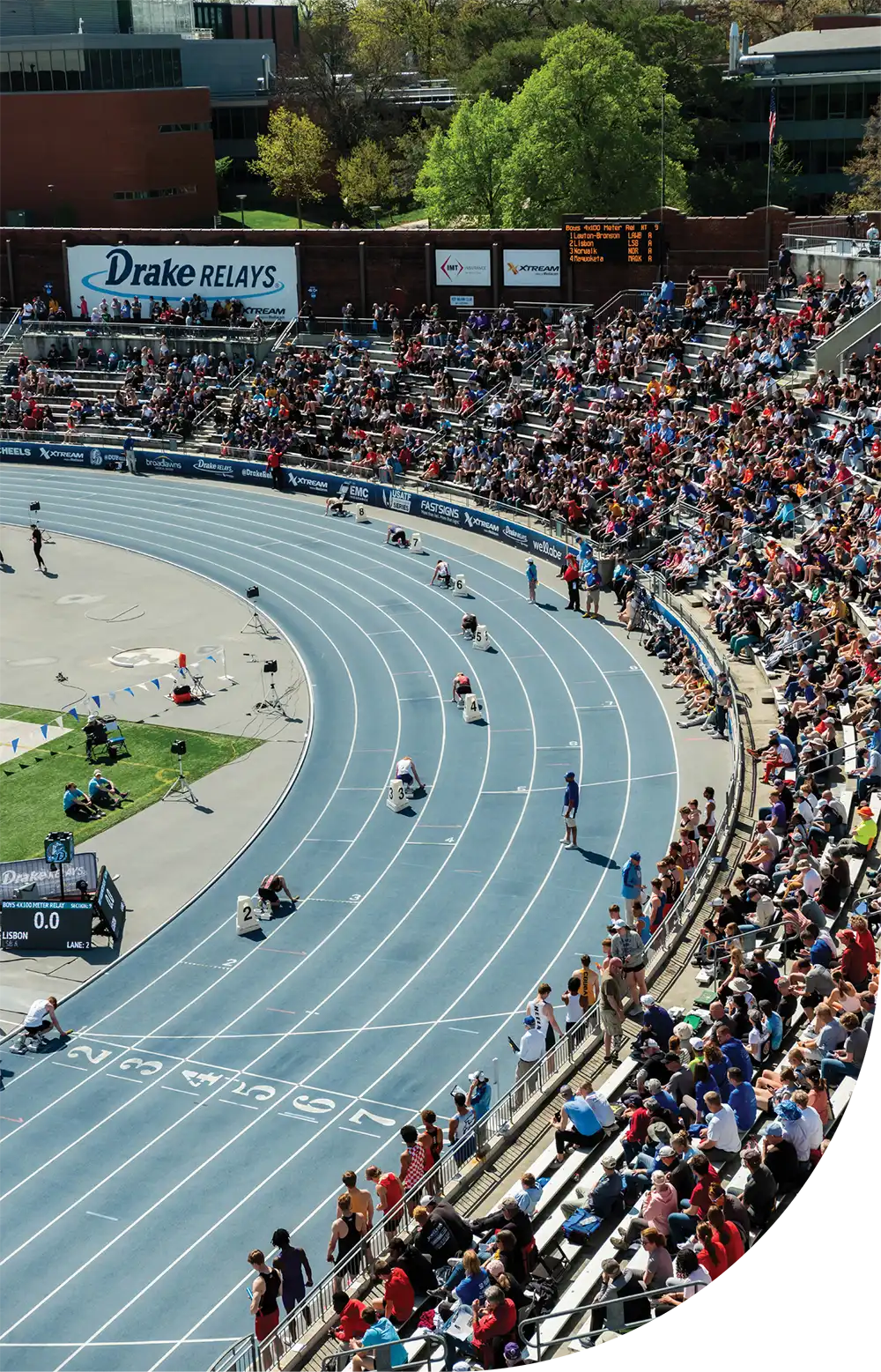
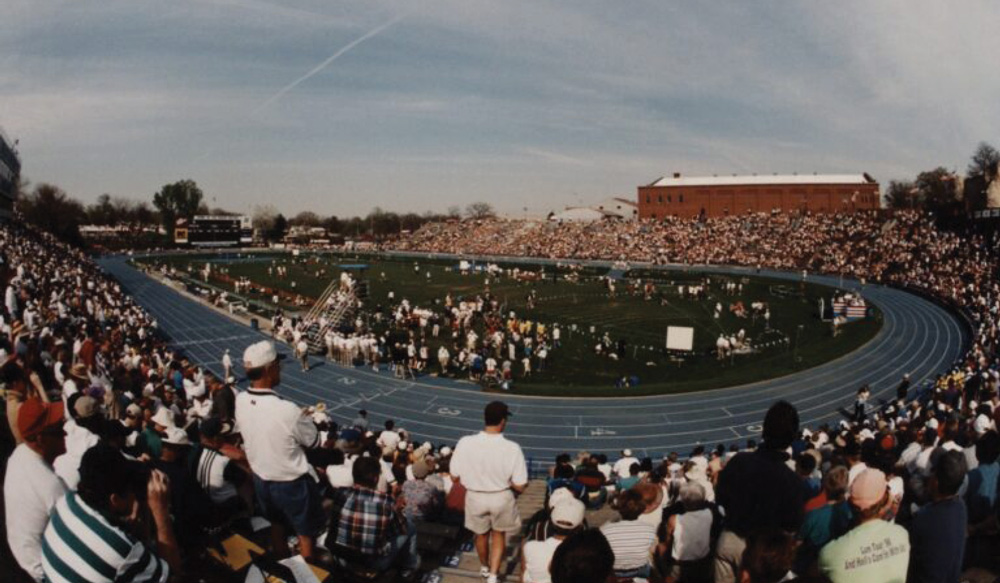
In 1989, one of the biggest changes in the stadium’s history was an update to the track surface. Drake installed a new blue tartan track surface and the “Blue Oval” was inaugurated. At the same time, the track was renamed “The Jim Duncan Track” in honor of the longtime Drake Relays public address announcer. Duncan began announcing the Drake Relays in 1951 and served in that role until 1989.
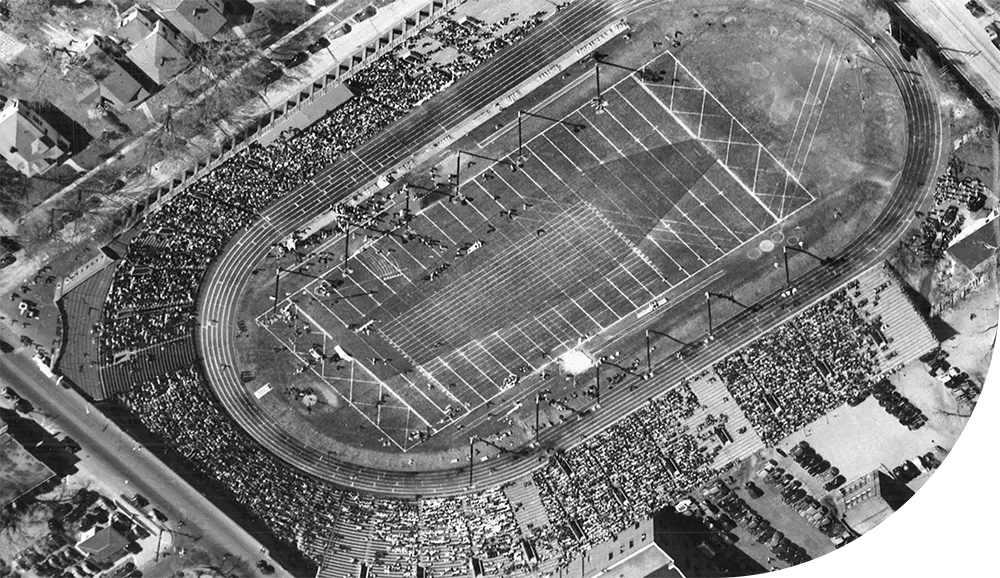
Years before Jim Duncan announced his first Drake Relays, former President Ronald Reagan broadcast the Drake Relays for WHO Radio. Reagan worked as a sports announcer for WHO Radio in Des Moines from 1933 to 1937.
Today, Mike Jay carries on the storied tradition of exceptional announcers of the Drake Relays at the stadium. Jay has been behind the microphone at Drake Stadium for nearly 20 years of Drake Relays and boys and girls high school state track and field meets.
Significant Renovation
- Widening track lanes from 42 to 48 inches
- Installing a new video scoreboard to the north of the stadium
- Changing the field from grass to turf
- Raising the field to the same height as the track
- Improving the seating, concessions, restrooms, and press box
- Adding a dedicated throwing event area north of the stadium
The stadium enhancements adjusted the capacity from approximately 18,000 to 14,557, allowing for the expanded lanes, athlete safety, and better viewing for throwing and running events.
“Those old 42-inch track lanes, before the stadium renovation, were tight,” said Mahon. “Now, at a full 48 inches, we’ve given these athletes the space they deserve. Even a great runner like Michael Johnson, with his 200-meter mastery, would point out the squeeze on those turns. It’s truly a night-and-day difference, much more accommodating for world-class speed.”
The horseshoe-type stadium design makes it possible for fans to be close to the athletes.
“When you get a capacity crowd, it just makes the athletes perform to the best of their ability,” Mahon said. “That explains why there are so many records set every year, whether it be state track meets, Drake Relays, USA Track and Field Championships, or the NCAA Outdoor Track and Field Championships.”
Renovation Leads to National Events
“You saw all the top collegiate athletes from around the country, and because 2008 was an Olympic year, that had special meaning,” said Mahon. “Many people don’t realize how lucky we are to see future Olympic stars perform as collegiates.”
Famous Athletes at Drake Stadium
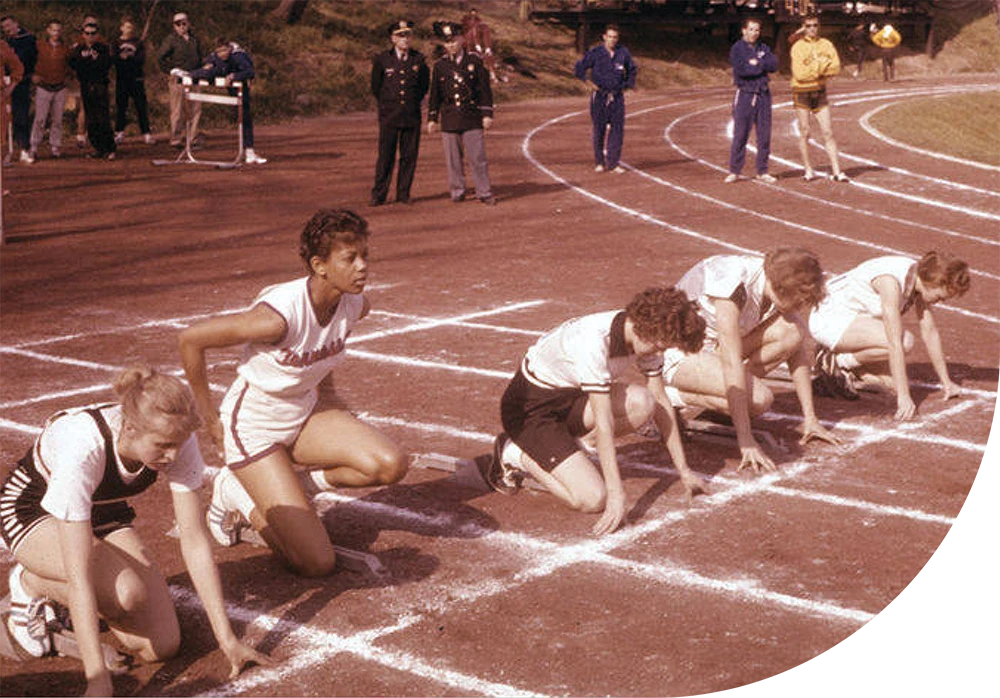
- Wilma Rudolph: In 1961, she ran in the first Drake Relays event for women—the 100-meter dash.
- Susie Favor Hamilton: Set records in 1998 (800 meters), 2000 (1500 meters), and 2002 (3000 meters).
- Shelby Houlihan: Won eight Drake Relays titles as a high school runner.
- Karissa Schweizer: Holds a Drake Relays record in the 5,000 meters from 2018.
- Merlene Ottey: Won four individual titles at the Drake Relays.
- Gwen Torrence: Earned the title of Drake Relays Female Athlete of the Century; won eight Drake Relays titles, more than any other female performer.
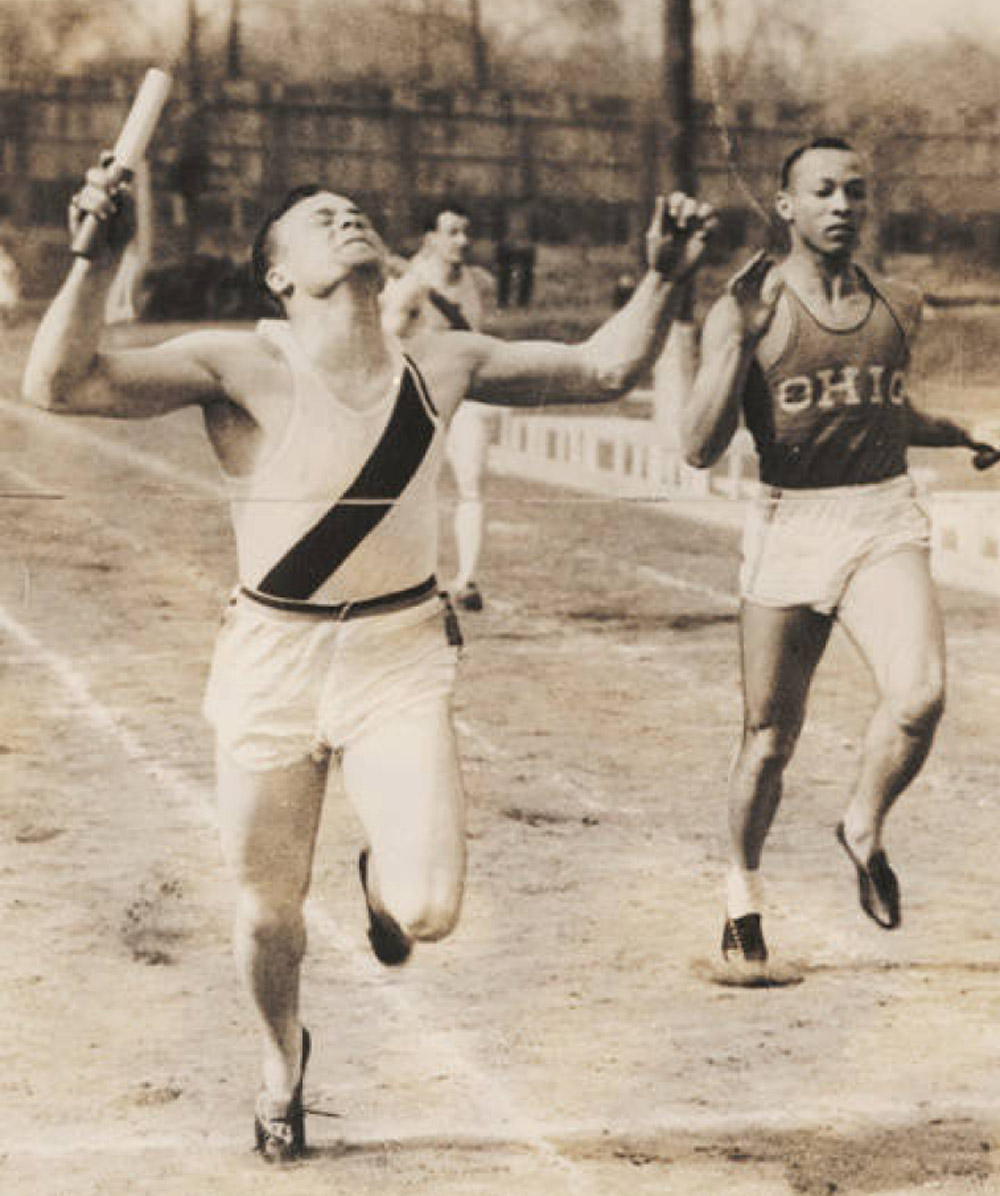
- Jesse Owens: Named the Drake Relays Athlete of the Half-Century in 1959.
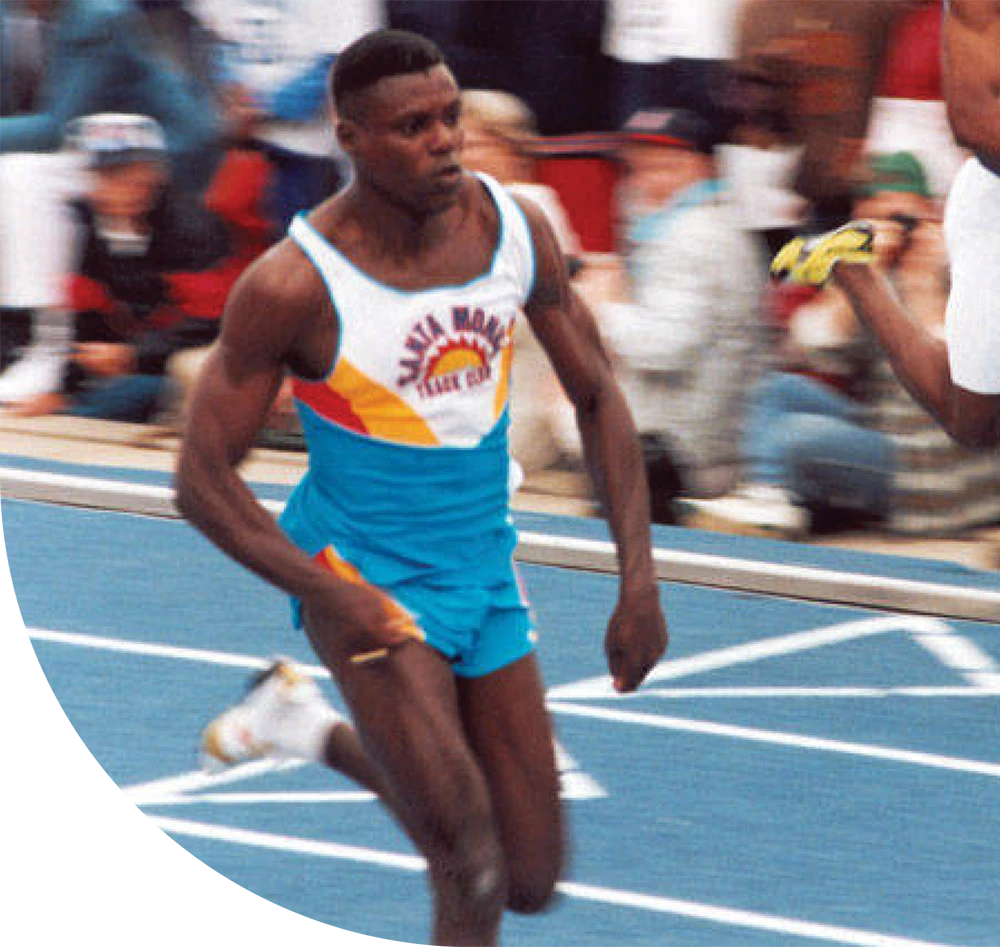
- Carl Lewis: The Olympic track star won the 100-meter dash at the Drake Relays in 1994. Before running, he helped shovel snow from his lane on the Blue Oval.
- Michael Johnson: Set World and American records in 1996 in the 200-meter dash.
- Wilt Chamberlain: The Hall of Fame basketball player competed in the 1957 Drake Relays in the high jump, tying for first place.
“Being there on the scene to witness a world record—that’s a memory you’ll have for the rest of your life,” said Mahon.
High School Track and Field Highlights
“One year, Tim Dwight was part of three records and won four events at the state meet,” said Schoffner. “At least one of them was a relay, and he set records in three. The only event he didn’t set a record in was the 200, and he had already set the record the year before. You always wanted to see him get the baton behind, just to watch him eat up the ground on the runners ahead of him.”
Another memorable Iowa high school track athlete, according to Schoffner, was Adam Haluska from Carroll High School, a basketball player who won four high school track events as a senior.
Countless other high school athletes have graced the Big Blue Oval during their careers—too many to recognize in the pages of this magazine.
Drake University remains committed to continued improvements and updates to keep the stadium a world-class venue for track and field events and Drake football games.
Big-Time Football
The following football teams played at Haskins Field or Drake Stadium. The first Drake football game played at Haskins Field was against the University of Iowa on October 8, 1904.
- Arizona
- Colorado
- Illinois
- Iowa
- Iowa State
- Kansas
- Kansas State
- Louisville
- Mississippi State
- Missouri
- Nebraska
- Notre Dame
- Oklahoma
- Oklahoma State
- Ole Miss
Drake Stadium Exhibit on Display
Drake University will host an exhibit featuring memorabilia, historical artifacts, and pictures from the 100-year history of Drake Stadium. The exhibit will be displayed in Cowles Library until May 2026. Benedict Chatelain, Reference & Instruction Archivist and Assistant Professor of Librarianship, prepared the materials and is overseeing the exhibit.

Historic
Highlights
1910
Drake University hosted the first Drake Relays at Haskins Field, the precursor to Drake Stadium. Haskins Field was named after Norman Haskins, a donor who provided the land and funds for its construction.
1928
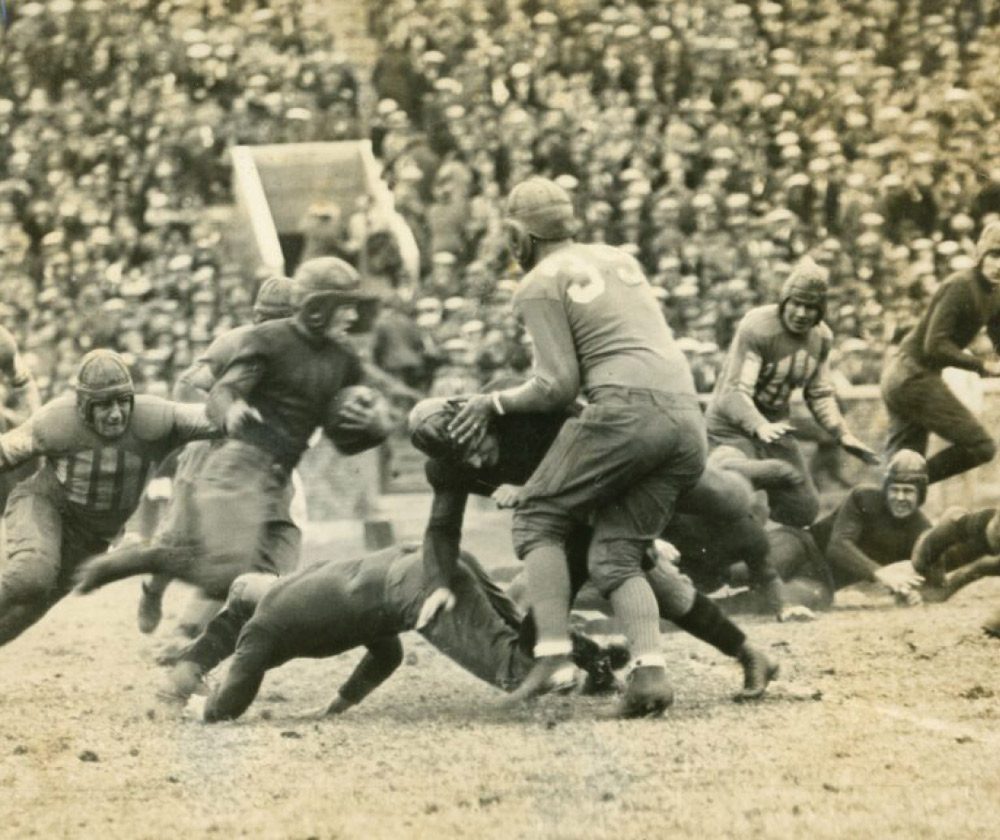
Drake is the first college to install permanent stadium lighting. Drake defeated Simpson College in the first night game at the stadium.
1933–1937
Ronald Reagan broadcasted the Drake Relays for WHO Radio.
1935
Jesse Owens won the 100-meter race and long jump at the Drake Relays. He went on to win four gold medals at the 1936 Berlin Olympics in Germany.
1969
A new synthetic red brown tartan track replaced the red, crushed brick cinder track.
1979
Steve Scott ran the first outdoor sub-four-minute mile at the Drake Relays.
1989
The track oval is renamed Jim Duncan Track in honor of the beloved announcer who served as the voice of the Drake Relays from 1951 to 1989. The Jim Duncan Track is resurfaced in Drake blue and earned the “Blue Oval” nickname.
1994
Carl Lewis won the 100-meter dash at the Drake Relays.
2000
William “Billy” Cundiff kicked a Drake record and Pioneer Football League record 62-yard field goal against San Diego. Cundiff played in the NFL and made six field goals in a single game for the Dallas Cowboys.
2005
Drake hosted the first-ever Iowa High School Boys and Girls State Track & Field meet.
2006
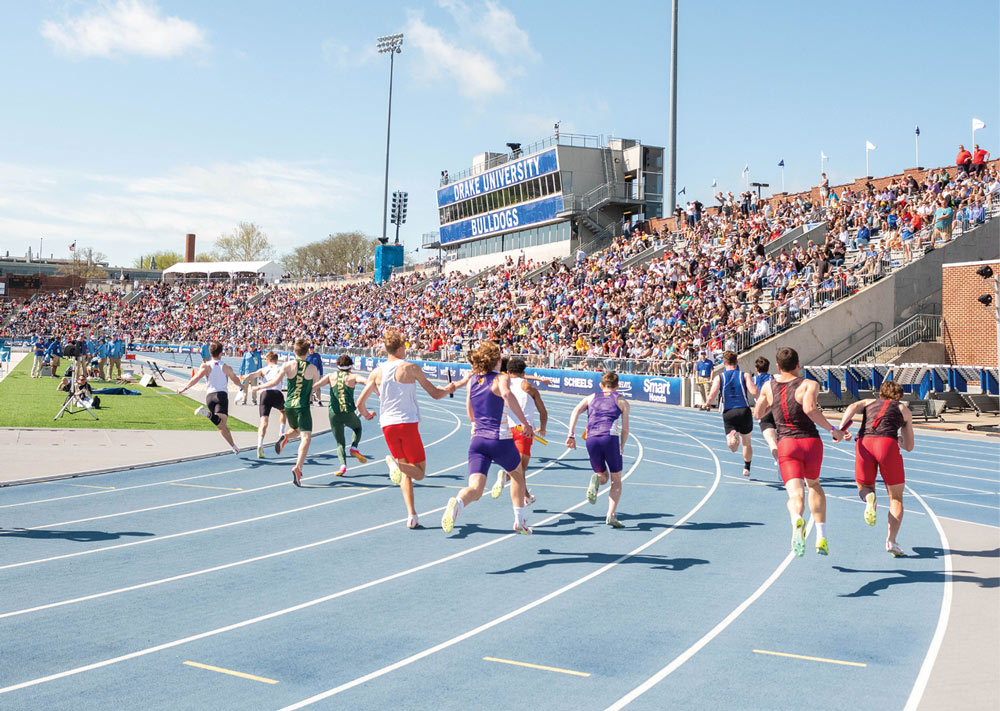
The football field at Drake Stadium is officially named “Johnny Bright Field.”
2008
Drake hosted the NCAA Outdoor Track and Field Championships. Drake also hosted the championships in 2011 and 2012.
2025
The 115th Drake Relays at Drake Stadium.
1925
Drake played Kansas State on October 10 in the football home opener at the newly constructed Drake Stadium. The stadium was originally designed for 18,000 attendees. Fans saw Drake beat Kansas State, 19-0, and later that season, the Bulldogs beat Nebraska, 14-0, to close out the home football schedule.
1926
On three consecutive Saturdays, Drake played home games in Drake Stadium against Oklahoma, Ole Miss, and Kansas. The Bulldogs beat Ole Miss, 33-15, and Kansas, 13-0.
1948–1951
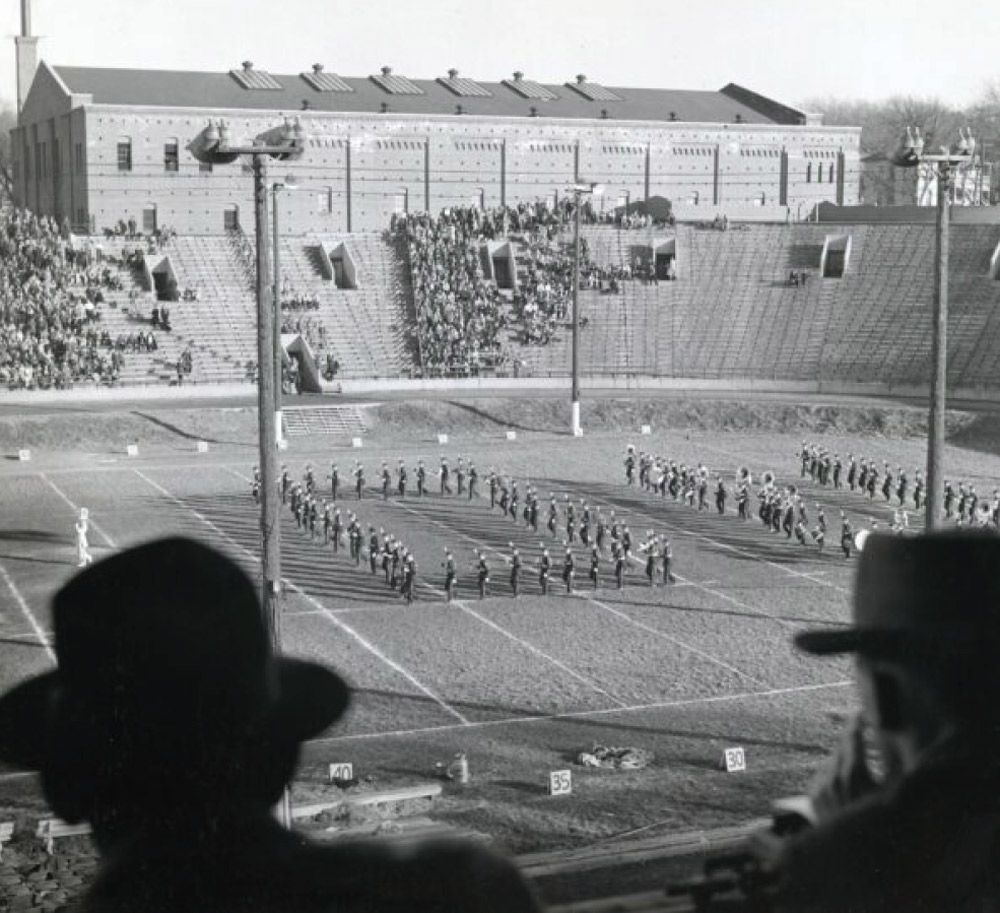
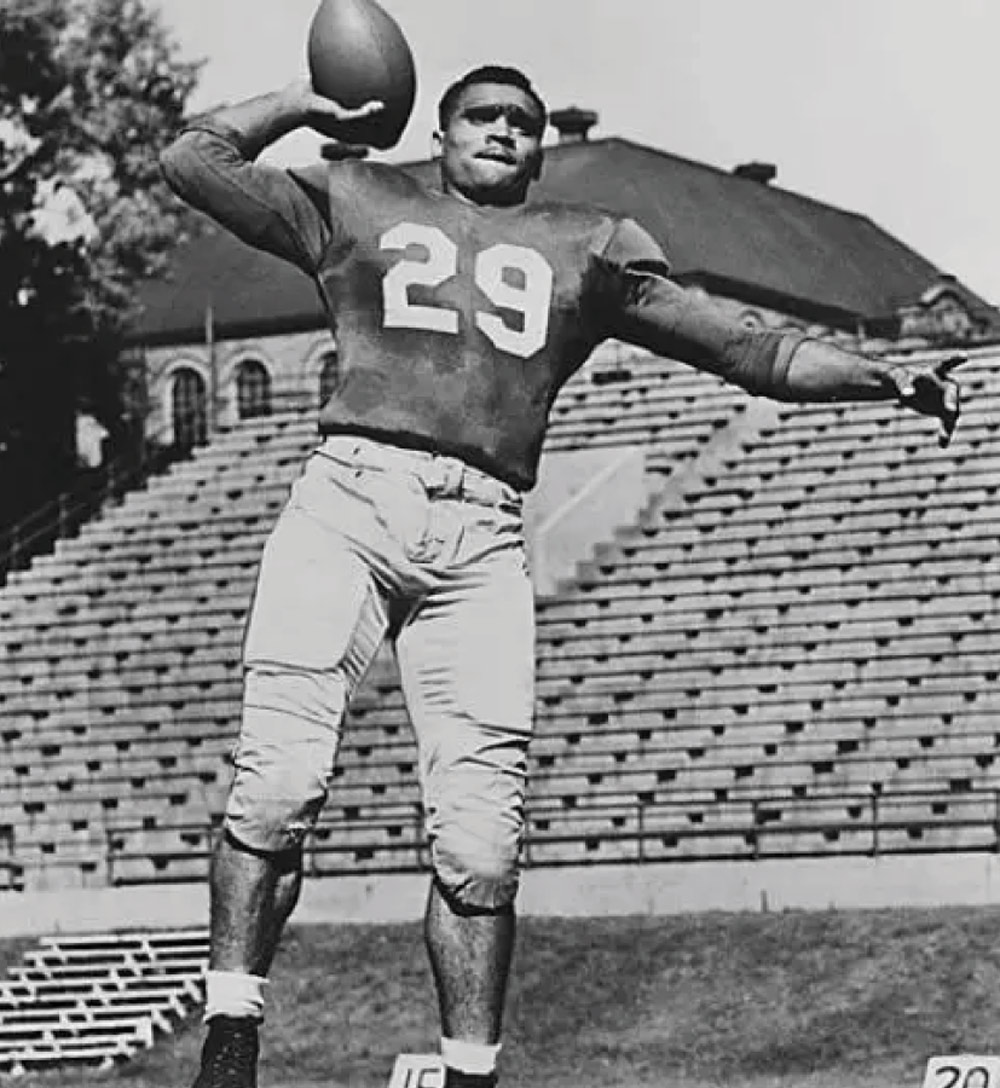
Johnny Bright played football at Drake University. The All-American Drake football player and Heisman Trophy candidate went on to play in the Canadian Football League (CFL). Bright was inducted into the College Football Hall of Fame and the CFL Hall of Fame.
1970
Drake hosted the NCAA Championships for the first time. Legendary Steve Prefontaine captured the first of seven NCAA career titles by winning the 3-mile run.
1981
The Drake football team finished its season with 10 wins, capping one of its most successful seasons.
1996
Michael Johnson won the 200-meter Special Invitational at the Drake Relays. Johnson went on to win the gold medal in the 200-meter and 400-meter races at the Atlanta Olympics.
2001
Florida Atlantic was the last NCAA Division 1 (FBS) team to play Drake at Drake Stadium, with the Bulldogs earning a 31-7 victory.
2005–2006
Drake completed a $15 million renovation project. A new throwing area was created north of the stadium, and the surface area of the stadium was flattened. Previously the infield sat several feet lower than the track surface.
2006
Drake Stadium hosted the first Reggie’s Sleepout in honor of Reggie Kelsey, a young man who aged out of the foster care system and eventually died homeless in Des Moines.
2019
Drake hosted the USA National Championships. Drake also hosted the championships in 2013, 2018, and 2019. At the four-day 2019 USA National Championships, one world record, three American records, and 18 Drake Stadium records were set.